
Stay Updated with WXING's News and Innovations.
Both cold heading and casting are ways to turn raw metal into finished parts. But they work very differently, and those differences have a direct impact on your cost structure, part quality, and production throughput. Choosing the wrong process — and the wrong equipment — can be an expensive mistake.
Let's break it down in a way that actually matters to you as a buyer.
Casting works by melting metal and pouring it into a mold. Once it cools and solidifies, you have a part. It's intuitive, and it works well for complex shapes that would be hard to form any other way.
Cold heading works completely differently. No melting involved. Instead, a metal blank — usually wire or rod — is fed into a machine and struck with a punch at high speed. The force displaces the metal into the die cavity, forming the part at room temperature. This is why it's called "cold" — the metal stays solid throughout the process.
That one fundamental difference — hot liquid vs. cold solid — drives almost every practical advantage cold heading has over casting.
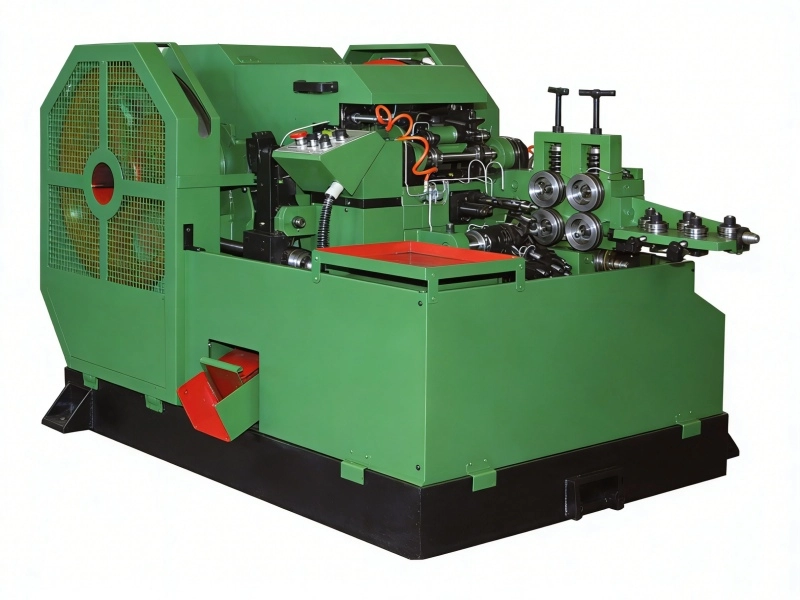
YT-1524 2 Die 4 Punch Cold Headers
| Factor | Casting | Cold Heading |
|---|---|---|
| Material Utilization | Significant scrap from sprues, runners, and risers — often 20–40% wasted | Near-net-shape forming; utilization typically above 95% |
| Part Strength | Cast grain structure can have porosity; fatigue resistance is limited | Continuous grain flow increases tensile strength and fatigue life |
| Production Speed | Slow — limited by melt, pour, cool, and trim cycles | Fast — hundreds or thousands of parts per minute are achievable |
| Dimensional Accuracy | Shrinkage and warping require allowances; often needs machining | Tight tolerances from the die; less secondary machining needed |
| Surface Finish | Moderate; mold texture carries over to the part | Smooth, consistent surface directly from the heading process |
| Upfront Equipment Cost | Lower for low-volume or prototype runs | Higher initial investment, but strong ROI at volume |
| Energy Consumption | High — furnaces run continuously | Lower — no heating required |
When you're casting, a meaningful portion of every pour ends up as scrap that needs to be remelted — and remelting costs energy and time. Cold heading uses close to 100% of the input material. At scale, that difference in material utilization alone can justify the equipment investment.
Because cold heading compresses and flows the metal rather than melting it, the internal grain structure stays intact and actually improves. The result is a part with better fatigue resistance and tensile strength compared to a cast equivalent. For applications like fasteners, connectors, and automotive components where part failure is not an option, this matters a lot.
Cold heading machines run fast. Once your tooling is dialed in, you can produce thousands of identical parts per minute with minimal operator intervention. Casting simply can't compete on cycle time for high-volume runs.
Cold heading is powerful, but it isn't the right answer for every job. Being clear about its limitations will help you make a better decision — and help you build credibility with your team when presenting options.
If you're sourcing a cold heading machine, the comparison with casting gives you a useful framework for building the business case internally. You're not just buying a machine — you're committing to a process with specific strengths. Make sure the parts you plan to produce are good candidates: moderate complexity, high volume, materials suited for cold forming (low-carbon steel, stainless, aluminum, copper alloys, titanium).
Also think about total cost of ownership. Cold heading tooling — punches and dies — wears over time and needs to be replaced. Understand the tooling cost and lifespan for your specific application before you finalize your numbers.
Before signing off on a cold heading machine, use these questions to pressure-test your supplier's claims and make sure the equipment fits your actual production needs.