
Stay Updated with WXING's News and Innovations.
In the modern fastener manufacturing industry, the multi-station bolt former machine has become a core piece of equipment for high-precision, high-volume bolt production. As an advanced application of cold heading technology, it integrates multiple manufacturing processes into a single machine, enabling fully automated production from metal wire to finished bolt blanks. This technology has completely transformed traditional fastener manufacturing, which was previously limited by low efficiency and scattered production processes.
A multi-station bolt former machine is an automated machine that manufactures metal fasteners by using cold heading forming technology.
Cold heading is a metal forming process performed at room temperature. Through the use of dies and punches, pressure is applied to metal wire materials, causing them to undergo plastic deformation and form the required shapes.
During the production process, metal wire is first fed into the machine through the feeding system and then passes through multiple forming stations in sequence:
1. Cutting the raw material
2. Initial upsetting forming
3. Head forming
4. Multiple precision stamping operations
5. Final formation of the bolt blank
Afterward, the products usually undergo additional processes such as thread rolling, heat treatment, and electroplating to complete the production of high-performance fasteners.
The metal wire is accurately transported into the equipment according to the set length through a roller servo mechanism.
Its features include: High feeding accuracy; continuous production; reduced need for manual operation
A stable feeding system can ensure consistent product dimensions.
This is the core part of the cold heading machine. It consists of multiple groups of dies and punches, which sequentially complete processes such as cutting, pre-upsetting, precision upsetting, head forming, punching, trimming, and other operations.
Different stations work together to perform various processing tasks, allowing complex bolt structures to be manufactured at one time.
It adopts a rotary swing-type clamp manipulator to achieve high-speed and accurate transfer of blanks between stations. Some models support 180-degree workpiece rotation.
After heading is completed at each station, the formed workpiece is smoothly pushed out from the die, or the workpiece is ejected by the ejector rod inside the punch to prevent die sticking.
Modern models are generally equipped with PLC or servo control systems, which can monitor the pressure and speed parameters of each station in real time and support automatic fault alarms.
It improves production stability and automation levels.
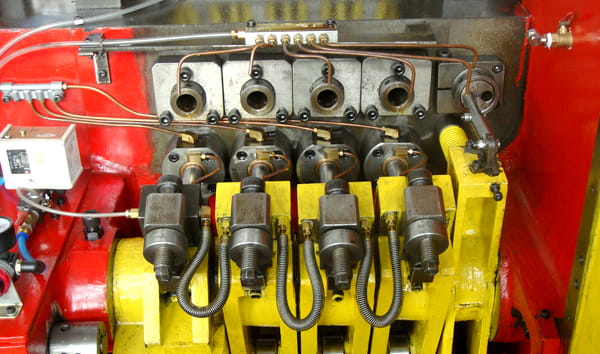
The multi-station bolt former machine has extremely high production efficiency. It integrates multiple stamping dies and does not require transfer between individual machines.
A single feeding process can continuously complete multiple complex processing steps, greatly shortening the production cycle of each piece. Its production capacity is far higher than traditional single-station equipment.
Using cold heading technology, metal is plastically deformed at room temperature. It not only eliminates the heating process but also avoids material waste caused by cutting processing, greatly reducing production costs.
During the cold heading process, the metal flow lines are not cut off, which makes the manufactured bolts have higher tensile strength and better fatigue resistance. The close cooperation between each station ensures high dimensional accuracy and consistent appearance quality of products.
The multi-station bolt former machine can process various metal materials, including copper, aluminum, carbon steel, alloy steel, stainless steel, and titanium alloy.
By replacing dies, the same machine can achieve processing of various types of components, providing strong flexible production capabilities.
The highly automated operation process reduces manual loading, unloading, and transfer procedures, lowering labor costs. At the same time, the compact single-machine multi-station design saves workshop floor space.
| Application Area | Typical Products |
| Automotive | Engine bolts, chassis bolts, wheel hub bolts, seat fasteners |
| Aerospace | High‑strength titanium alloy fasteners, special connectors |
| Rail Transportation | Railway track fasteners, locomotive connection bolts |
| Machinery Manufacturing | Industrial equipment connectors, sewing machine parts |
| Construction | Structural anchor bolts, high‑strength connectors, building hardware |
| Electronics & Appliances | Precision screws, micro fasteners |
| Military & Marine | Specialty fasteners, corrosion‑resistant connectors |
| Civilian Products | Furniture screws, daily hardware, bicycle parts |